Why Reporting to Your Customers Isn't Optional Anymore
If you run a managed service on top of ServiceNow, you already have everything your customers need to trust you more: the tickets, the response times, the resolution history, the trends. The problem isn't the data. It's that it sits locked inside your instance, invisible to the people paying for the service.
Every month without a report is a missed opportunity to prove value. Customers who don't see what you're doing for them start asking what they're paying for. They compare you to competitors on price alone, because price is the only thing they can actually see. And when a renewal conversation comes around, you're arguing from memory instead of from twelve months of documented evidence.
A regular, branded, professionally produced service delivery report closes that gap. It turns invisible operational work into visible, quantified value, generated automatically every month, without anyone on your team lifting a finger.
What the Report Actually Shows
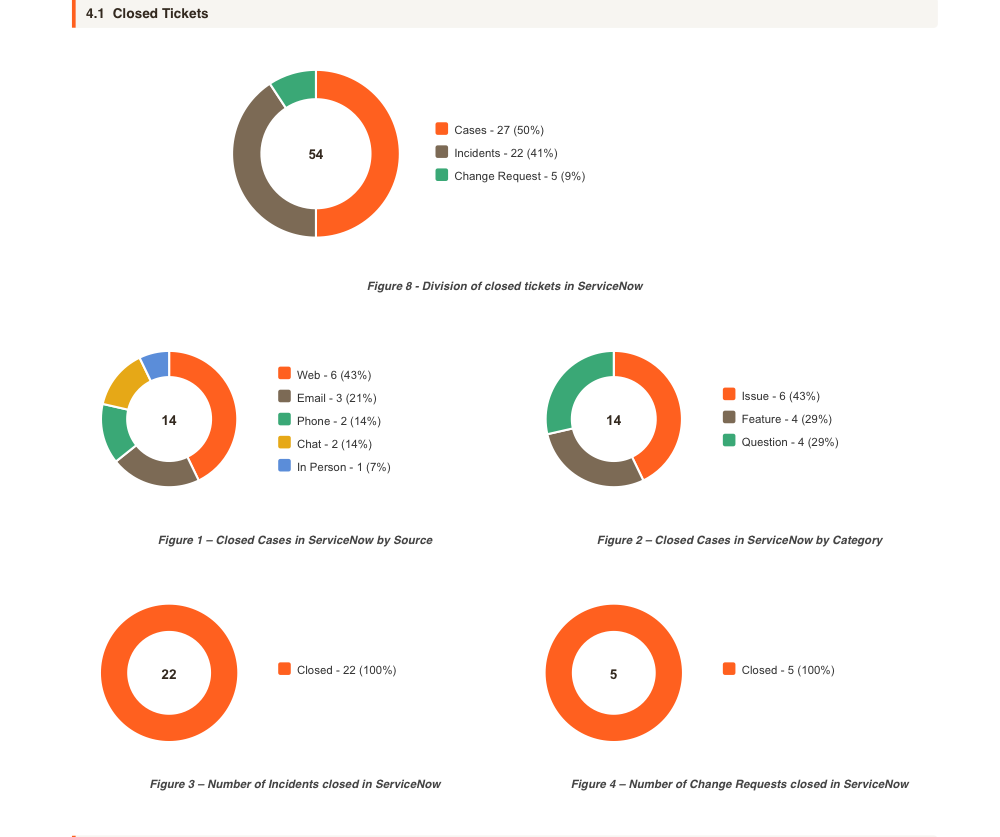
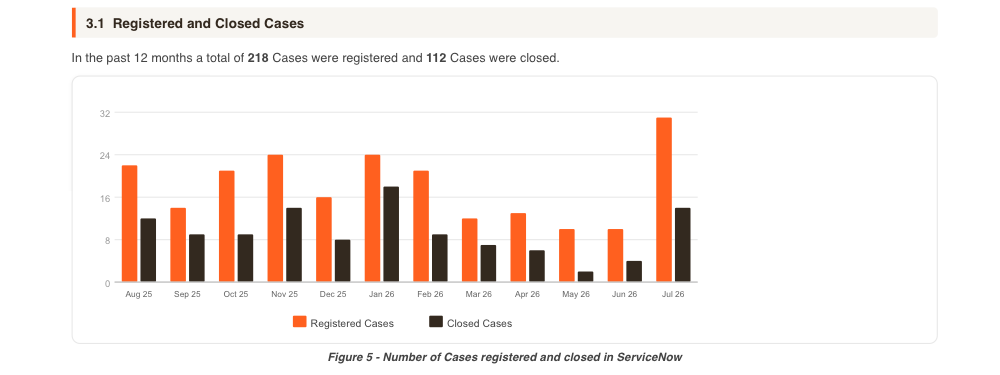
Each report gives the customer a complete, easy to read picture of their service for the period: a management summary of cases, incidents, and change requests registered and closed; SLA performance measured against agreed targets, with breaches clearly flagged; twelve month trends so customers see the trajectory, not just a snapshot; service insights on where tickets come from and what they're about; full transparency on P1 incidents against SLA; and closed change requests grouped by outcome, so change quality is on the record.
It's not a data dump. It's a structured narrative: here's what happened, here's how fast we handled it, here's whether we hit our targets. Built directly from live ServiceNow data, styled with the customer's own branding, and ready to send without manual assembly.
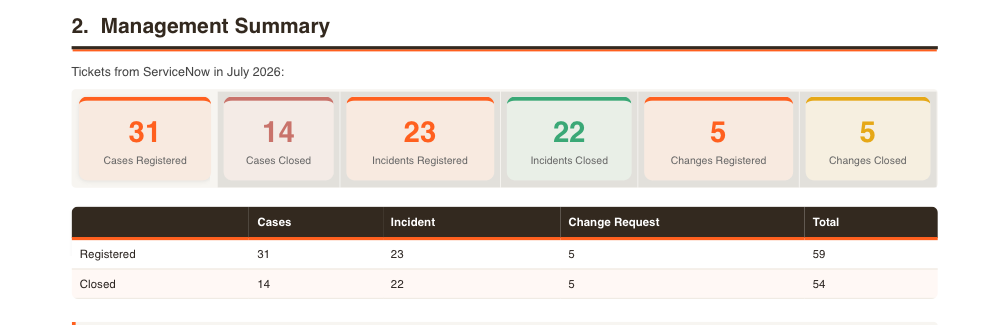
The same report breaks closed tickets down by type, source, and category, each as its own chart rather than a table the reader has to interpret themselves.
The Reporting Engine You Already Have Wasn't Built for This
"Doesn't ServiceNow already have reporting?" It does, and for a quick, internal, ad hoc lookup, it's genuinely fine. The wall you hit is a different job: automatically generating and sending a polished, recurring report to an external customer every month.
Standard Reports and Report Designer are built to report on a single table. Your service story lives across five or more: cases, incidents, changes, SLA definitions, and contact relationships. Pulling them into one view natively means an admin has to build and maintain a Database View to join those tables together, and that comes with its own problems: it can duplicate rows in charts and reports, and pulling in data from related records often needs extra configuration. It works. It's a workaround someone has to build and keep owning, not a feature.
It doesn't scale across customers either, and it doesn't look like you. A Scheduled Report is one definition tied to one fixed recipient list, so sending a uniquely filtered report to each account means building a near identical version by hand, then doing it again for every new customer. Native exports also use a shared, generic template, so a genuinely branded document, your logo, your colours, your layout, needs custom UI pages and PDF generation on top, and delivery to people outside your instance is never fully guaranteed.
That combination of walls is exactly why so many organisations end up copying their ServiceNow data into a datalake and buying a general purpose BI tool to lay it out the way they actually want it presented. That's a lot of infrastructure, licensing cost, and integration work, and it's solving a problem that doesn't need solving that way for a report drawing solely on ServiceNow data.
For this kind of static, periodic reporting (customer reporting, management reporting, anything produced on a monthly or quarterly cadence), the answer isn't a heavier reporting stack. It's advanced reporting: a purpose-built reporting service built from native ServiceNow building blocks. Server side scripting assembles the multi table view properly instead of leaning on a fragile Database View, a generation step produces a uniquely filtered, correctly branded document per customer automatically, and distribution runs on ServiceNow's own scheduling and email capabilities rather than a separate system. None of it requires the data to leave ServiceNow. We build it once, configured to your instance, and it runs for every account from then on.
Why You Can't Afford to Skip This
It's your best renewal argument. When contract time comes, you're not reconstructing a year of service from memory. You're pointing to twelve reports that already told the story.
It's a trust machine. Customers who receive consistent, honest reporting, including the months where SLA wasn't perfect, trust you more, not less. Transparency reads as competence.
It heads off escalations before they happen. A customer who sees a dip in performance in this month's report and gets context is a very different conversation than a customer who discovers it themselves and calls angry.
One Service Delivery Manager can credibly manage far more accounts when the monthly "here's how we're doing" conversation is backed by an automated report instead of a manually built slide deck.
It scales account management, and it differentiates you from every competitor who talks about transparency but doesn't hand customers documented proof of it every month. And once configured, it costs you nothing to run. It generates and distributes itself on schedule, pulling directly from data you already maintain.
A Dashboard Isn't a Substitute for a Report
Some will argue this is outdated, that self service dashboards have made periodic reporting redundant. It isn't that simple, and it isn't either or. A live dashboard and a report answer two different questions, and a serious managed service needs both.
A dashboard tells you how things look right now. Query it today, query it again next month, and you'll get whatever the current state of the data says, not what it said the last time you looked. That's exactly what makes it useful for day to day operations, and exactly why it can't do a report's job.
What customers actually want from a report is something a dashboard cannot give them by design: a fixed, dated record of what you told them happened, one that doesn't quietly change if they come back and check again in three months. Not a live view they have to trust is accurate at the exact moment they're looking at it. A number they can hold you accountable to, exactly as it stood on the day you sent it.
That's not a technical footnote. It's the whole point of a report. A dashboard is a window. A report is a receipt.
But a receipt only works if it actually arrives, correctly, every time. One that's late, misbranded, or built by hand for one account and forgotten for the next isn't something a customer can be held to. That's the same set of walls from earlier: a report worth calling a receipt is only as good as the service that produces it, and that's exactly what the native tools weren't built to do at scale.
Making the Report Smarter: An AI-Generated Summary
There's a natural next step once the report itself is automated: an AI-generated executive summary at the top, written fresh each period, calling out what actually changed. A rising trend in a ticket category. An SLA that slipped, and why. A change type generating repeat issues. Applied to the same sample report shown earlier, that summary reads like this:
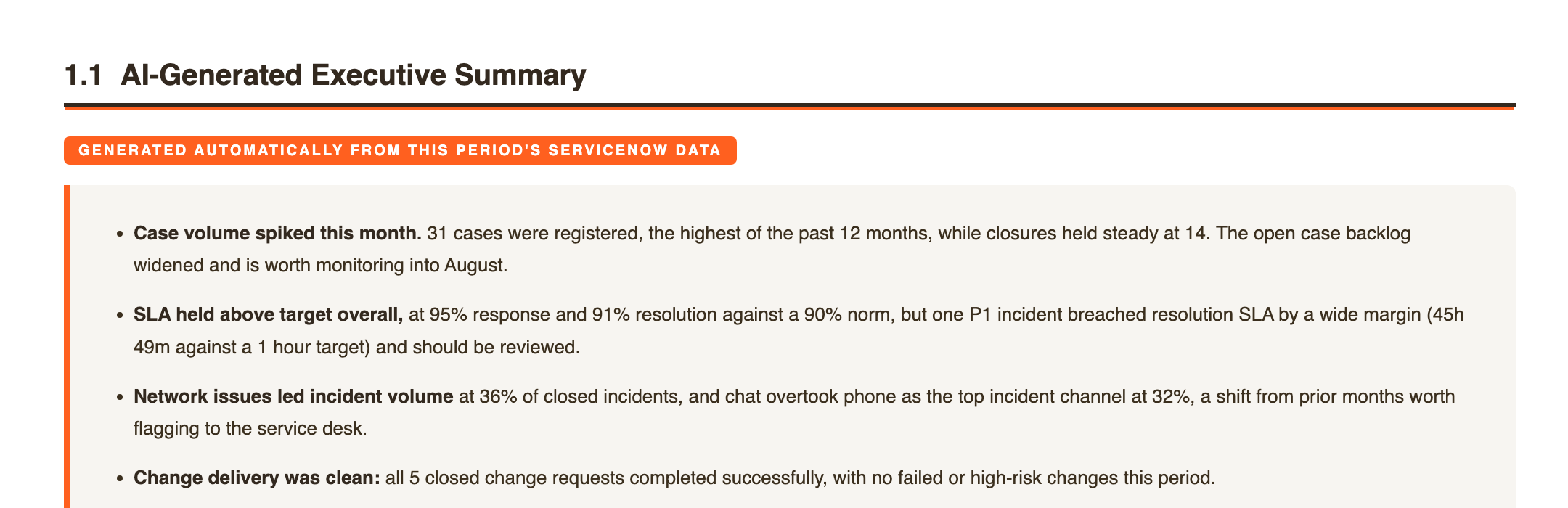
The takeaway in thirty seconds, the evidence right below it.
Customers reading the summary get the headline immediately. Anyone who wants the detail scrolls down to the tables and charts that support it. It's the same underlying idea as our AI-powered delivery work elsewhere: using AI to compress the distance between data and decision.
The Bottom Line
Your customers are already deciding, every month, whether you're worth what they're paying. You can leave that decision to their memory and their mood, or you can hand them the evidence yourself, automatically, in a report that looks as professional as the service you actually deliver.
Want to see what this looks like for your service?
Let's talk about what a purpose-built reporting service could look like on your ServiceNow instance, built once from native ServiceNow building blocks, and ready to reuse for every account.
Speak with us