The Platform Is Solid. What You Built On It Isn't.
ServiceNow, as a platform, is remarkably robust. Uptime is high, the core is stable, and in our experience it rarely fails on its own. That reliability is real — and it is exactly what creates the problem. Because the platform runs so solidly, teams extend it with the same confidence: custom applications, integrations, scheduled jobs, data feeds between systems. Those extensions do not inherit the platform's robustness. They inherit whoever built them, under whatever deadline they were built to, and however much attention they have had since.
The Question Most Platform Teams Can't Answer
Ask your ServiceNow team a simple question: if an integration failed silently last night, how would you know? Not whether someone would notice eventually — how would you know, this morning, before a user tells you.
Most teams cannot answer that confidently. The failure modes are predictable once you look for them: scheduled jobs that stop firing without triggering anything, integrations that fail silently because nobody built error handling into the job, log files quietly filling with errors nobody reads, configuration drifting away from what was originally intended. ServiceNow does not alert you to any of this by default — a failed scheduled job simply shows a failed state in its run history. Unless someone has explicitly wired up a notification, nobody is told.
Each of these is a silent operational gap — invisible until an outage forces a scramble, or someone finally asks: is this actually running the way we think it is, and how would we know?
When Users Feel It Before You Do
The business does not experience "an integration failed." It experiences a case that never routed, a report that is quietly wrong, an approval missing context because the record behind it never loaded. Users lose confidence in the platform — but the platform usually is not what failed. What failed was the unmonitored connective tissue around it: the piece nobody owns once it is working.
This is not a criticism of the teams who built these integrations. It is what happens by default. Components get built by different teams, under deadline pressure, and left alone the moment they work — because there is always a next delivery deadline, and monitoring hygiene has no deadline pushing back.
The best ServiceNow teams treat this as a point of pride, not just a risk to manage. They want to be the ones who find and fix an issue before the impacted part of the business ever notices it — not the ones who hear about it first through a support ticket, a frustrated Teams message, or a director asking why a process broke overnight. That is the real measure of a well-run platform team: not how fast you respond once someone tells you, but how rarely someone has to.
Watching for the Blind Spots
The fix is not more people staring at dashboards. It is a system that watches continuously and tells you before your users do. That is what we deliver as a configured template on client instances: a scoped monitoring application that runs continuous checks across your instance's components and integrations — queries, log files, system properties, script execution, REST calls — on schedules you control, from 24/7 coverage to business hours only.
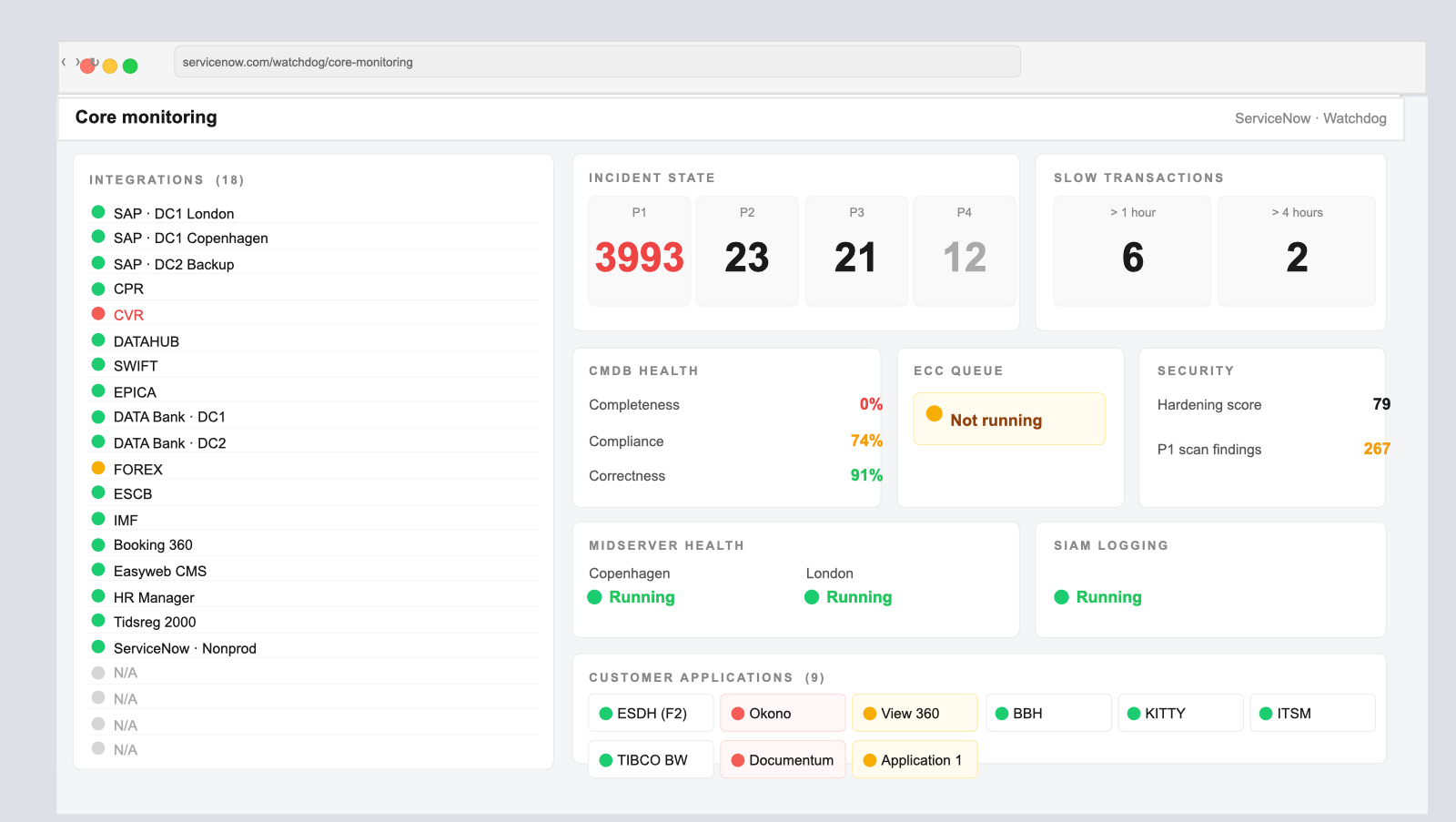
The same approach extends to security and compliance posture — hardening score, patch compliance, vulnerability counts, and certificate expiry, monitored continuously rather than checked at the next quarterly review.
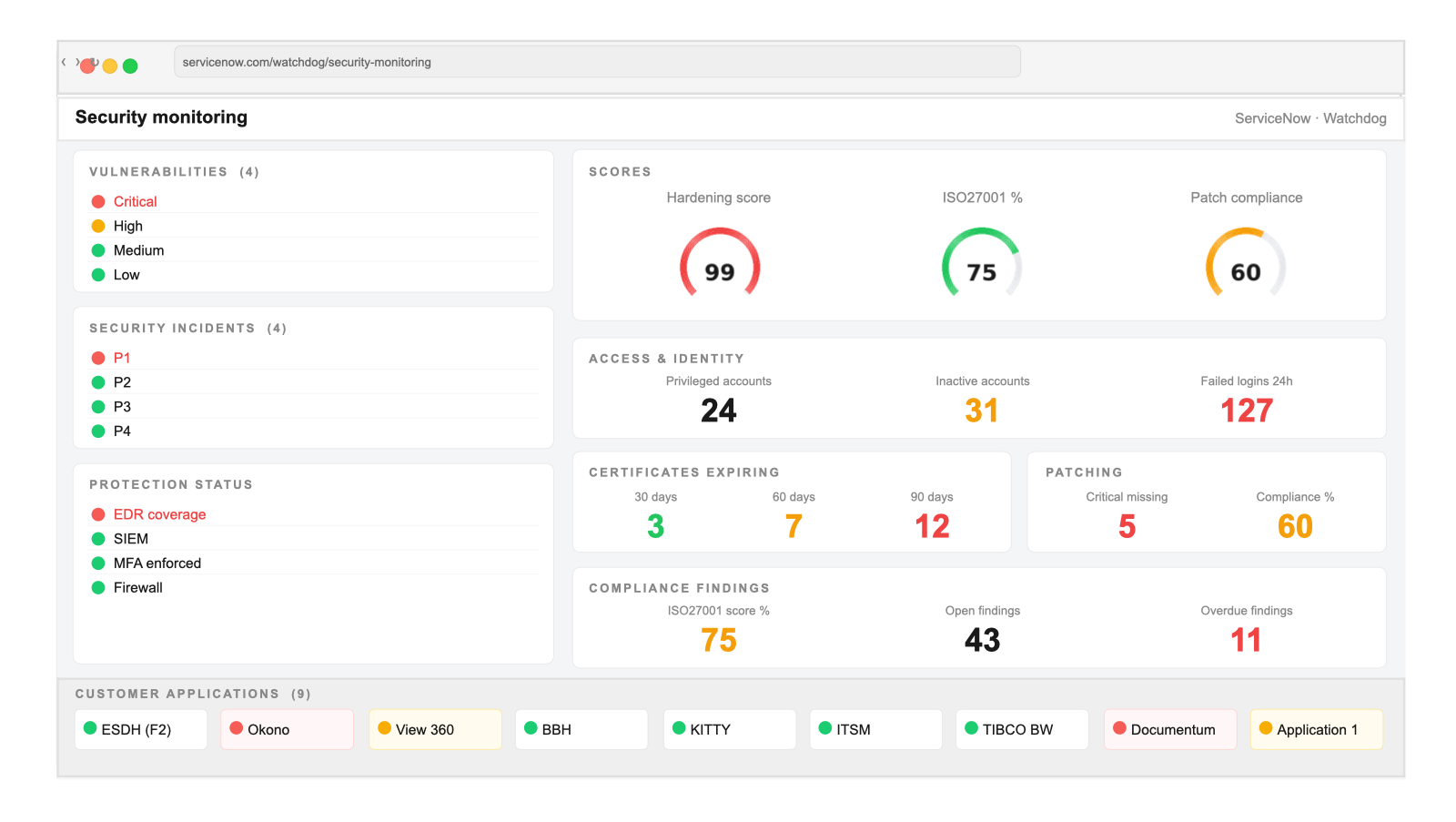
When a check detects a real issue, Watchdog notifies the right people immediately — often by raising an incident directly, so the problem is caught the moment it happens rather than discovered hours later. In some cases it goes further: based on the specific event, it can automatically enable or disable other components, stopping a failing integration from doing further damage without waiting for a person to step in.
Faster detection. Faster response. Sometimes no manual response at all.
What used to be reactive firefighting — someone eventually noticing, then tracing back to find the cause — becomes a system that catches and contains the problem on its own, with a live dashboard giving you a current picture of instance health instead of a guess.
The Real Question
Your ServiceNow platform is probably fine. The question worth asking is whether you would actually know if it wasn't — or whether you are relying on a user to tell you first.
Not sure what's running silently in your instance?
Let's talk about what monitoring hygiene looks like for your platform — and where your blind spots probably are.
Speak with us